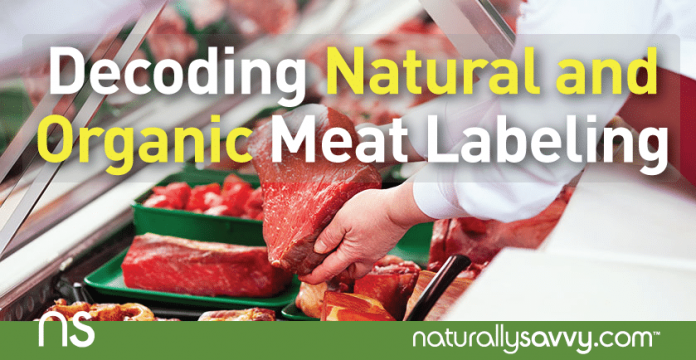
Consumer demand is growing for more natural and organic products. While organic vegetables and fruit top the food list, we’ve been slow to move beyond organic milk and free run eggs for animal products. However, increasing concerns about how animals are raised, meat processing practices, chemical additives and food safety have boosted the market for animals raised on a 100 percent organic diet; living under low-stress, free-range conditions; and without hormones or antibiotics.
Organic Meat
Both conventionally and organically raised meats must meet all requirements established by the USDA, however, meats and animal products labeled “organic” must also follow strict organic standards.
To receive certification, the animals must be fed organic feed and raised without the use of antibiotics, growth hormones, or any synthetic substances. In addition, animals must have access to pasture and be allowed to engage in their natural behaviors. Slaughter and production must take place in a certified facility and the use of synthetic processing agents, sulfites, nitrates or nitrites is prohibited. Packaged and processed foods containing animal products may not be 100 percent organic unless specifically labeled.
Under the USDA's National Organic Program (NOP), different labeling requirements have been established to distinguish levels of purity depending on the percentage of organic ingredients used in a product. Products labeled “Organic” must be at least 95 percent of the ingredients are organic. “Made with organic ingredients” means at least 70 percent of the ingredients are organic. A maximum of three organic ingredients may be listed on the primary display panel along with the “Made with organic ingredients” tag, however, the USDA organic seal may not be used. Products containing less than 70 percent organic ingredients may claim “Some organic ingredients” on their labels, and no USDA organic seals may be used. Review this fact sheet with more detailed information about product labeling.
For detailed information on the USDA’s organic standards, visit the National Organic Program website.
Read More: 5 Things You Thought You Knew About Organic Labeling But You Don't
Natural Meat
The Food Safety and Inspection Service (FSIS), a sister-organization to the USDA, currently allows processors to claim meat and poultry products are natural provided those products undergo minimal processing and contain no artificial flavors or colors, no chemical preservatives and no other synthetic ingredients.
Unlike organic, the "natural" label does not require a certification process. Even though the natural designation does not restrict the use of growth hormones, antibiotics, animal-by products, or consider the animal's welfare, many natural producers avoid using feed grown with chemicals, antibiotics and growth hormones, and they follow humane animal husbandry practices. Look for brands that are antibiotic- and hormone-free, with animals raised on a 100 percent vegetarian diet; the animals should not be fed any animal by-products.
Grass Fed
Grass fed animals live in pastures rather than feedlots. “Grass fed” or “pasture-raised” often means the animals were probably raised without the use of antibiotics, hormones or feed made with animal by-products as well, though this is not guaranteed.
Ranchers in the grass fed market tend to be good land stewards that are concerned with proper grazing techniques and nurturing of native grasses.
Read More: The Health Benefits of Grass Fed Beef
Free-Range
At this time, all USDA definitions of “free-range” refer specifically to poultry. There is no definition for “free-range” beef, pork or other animals.
Since there are no specific criteria given for the range space given to animals, the term is sometimes used misleadingly. The term suggests animals are permitted to engage in their natural and instinctual behaviors. To qualify for free-range certification, animals must be allowed access to the outside. It's important to note that free-range does not mean organic.
Certified Humane Label
The “Certified Humane Raised & Handled” label is a consumer certification and labeling program which assures consumers that animals have been raised humanely. Unveiled in 2003 by Humane Farm Animal Care (HFAC), the label guarantees that a meat, poultry, egg or dairy product has been produced according to HFAC’s precise standards for humane farm animal treatment.
Animals must receive a nutritious diet without antibiotics or hormones and must be raised with shelter, resting areas and space sufficient to support natural behavior.
Ten companies are currently certified to use this new label. HFAC is a national non-profit organization supported by the American Society for the Prevention of Cruelty to Animals (ASPCA), the Humane Society of the United States (HSUS), regional and local animal protection organizations, foundations and individuals.